Moderne MCP server
The Moderne CLI includes a local Model Context Protocol (MCP) server that gives AI coding agents tools for semantic code search, navigation, and refactoring. It runs on your own workstation as a subprocess of your coding agent, operating directly on the repositories you have checked out locally. While skills teach agents how to work with recipes, the MCP server gives agents direct access to these tools, backed by OpenRewrite's Lossless Semantic Tree (LST) and Moderne Trigrep.
This page describes the local MCP server (mod mcp), which runs on a developer workstation through the CLI. Moderne also offers a remote MCP server hosted on the Moderne Platform that runs recipes against the repositories already ingested into your tenant.
The local MCP server is experimental. While the tools work, agents don't call them consistently. There are two main reasons for this:
- Several Moderne tools overlap with the search and file reading an agent already has - so it may skip a Moderne one even when that one would do better.
- Agents like Claude Code, Cursor, and Copilot ship frequent updates that change how they select tools - so a Moderne tool that gets picked reliably in one release may be ignored after the next.
Because of this, the local MCP server is best treated as something to experiment with rather than to standardize on. To put an agent to work across an entire code estate, agent chat is the better fit today - it gives the agent the whole Moderne CLI on a synced organization. Moderne Platform customers can also use the remote MCP server to work across the repositories already ingested into their tenant.
Why use the Moderne MCP server
AI coding agents are limited to the tools bundled with them (typically just text search and file reading). These tools work at the text level and miss the semantic structure of code.
The Moderne MCP server gives agents:
- Indexed code search that returns results in milliseconds regardless of repository size
- Semantic navigation that understands types, methods, annotations, and inheritance hierarchies
- Codebase-wide refactoring that updates all references atomically, like an IDE rename
- Recipe execution that runs OpenRewrite recipes directly from the agent conversation
- Structural matching that finds code patterns spanning multiple tokens or lines
Because these tools are backed by a semantic model of your code, they understand it the way a compiler does - rather than text like a traditional tool would.
How it works
The MCP server must be started from within a git repository. If the working directory is not part of a git repository, the server will exit immediately and none of the tools will be available.
When the MCP server starts, it builds two things in the background:
- Moderne Trigrep: a pre-computed trigram index that enables sub-second text search across the entire repository. This powers the
trigrep_searchandtrigrep_structural_searchtools. - LSTs (Lossless Semantic Trees): a type-attributed tree representation of your source code that enables semantic tools like
find_types,find_methods,change_type, and recipe execution.
Tools become available progressively as each build completes. You can check their progress with the build_status and lst_status tools.
Available tools
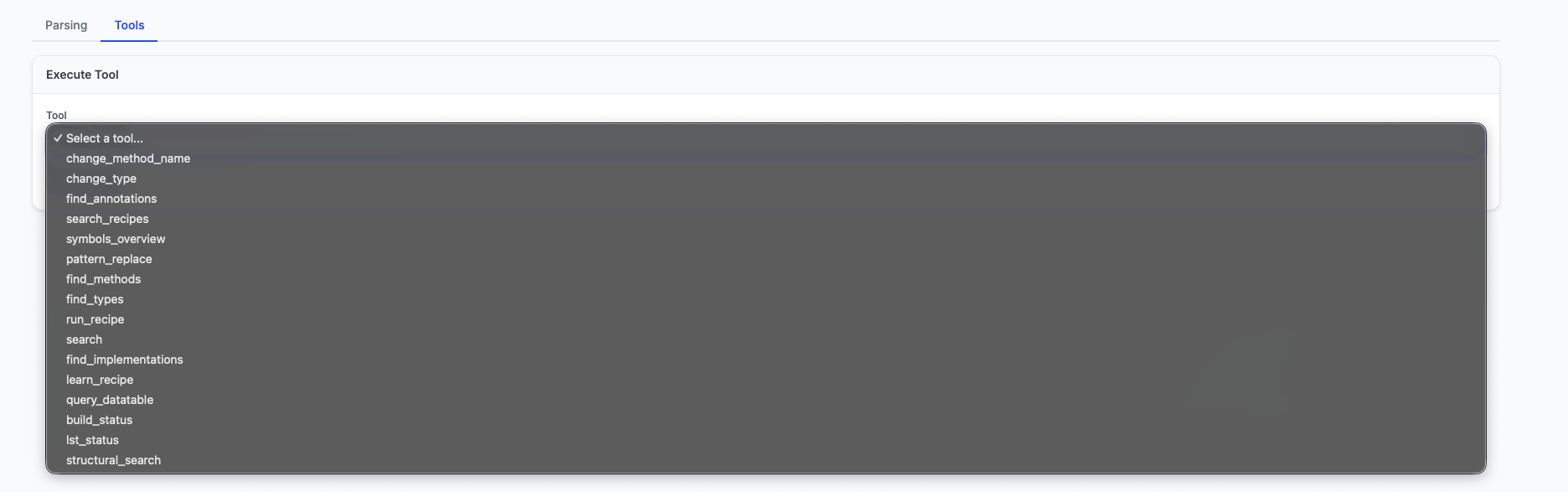
The MCP server exposes the following tools:
Indexed search
| Tool | Description |
|---|---|
trigrep_search | Searches the codebase using a pre-built trigram index. Faster than grep/ripgrep because it uses indexed search, returning results in milliseconds regardless of repo size. Supports plain text, regex, and filters (lang:, file:). |
trigrep_structural_search | Searches using Comby structural matching over the trigram index. Use this when you need to find code patterns that span multiple tokens or lines, such as method signatures, call patterns, or control flow. Uses :[hole] placeholders that respect balanced delimiters. |
grep | Linear file-content search using ripgrep or the system grep binary. No index required, so it is available before the trigram index finishes building. Prefer trigrep_search once the index is ready. |
Semantic search
| Tool | Description |
|---|---|
find_types | Finds all references to a type across the codebase, including imports, field types, method parameters, return types, type casts, instanceof checks, annotations, and generic type arguments. |
find_methods | Finds all invocations of a method across the codebase. Uses AspectJ-style method patterns to match method calls. |
find_annotations | Finds all usages of an annotation across the codebase, including on classes, methods, fields, parameters, and more. |
find_implementations | Finds all classes that implement an interface or extend a class, including indirect implementations through the entire type hierarchy. |
symbols_overview | Lists all symbols (classes, interfaces, enums, methods, constructors, fields) in a specific file or across the entire codebase. |
Editing code
| Tool | Description |
|---|---|
change_type | Renames or moves a type across the entire codebase. Updates all imports, references, declarations, and usages, equivalent to an IDE's "rename type" refactoring applied across the whole repository. |
change_method_name | Renames a method across the entire codebase. Updates all call sites, declarations, and references, equivalent to an IDE's "rename method" refactoring applied across the whole repository. |
pattern_replace | Compiles and runs a Kotlin recipe-DSL source (the rewrite { } to { } shape) to make structural code changes across the codebase. Use when edit_code finds no fitting marketplace recipe. |
Working with recipes
| Tool | Description |
|---|---|
edit_code | Finds a curated marketplace recipe that transforms code across the repository. First step, before learn_recipe and run_recipe. |
analyze_code | Finds a curated recipe that analyzes code across the repository without modifying it. Feeds query_datatable for structured results. |
learn_recipe | Retrieves full details for a specific recipe, including its description, configurable options, and data table schemas. |
run_recipe | Runs an OpenRewrite recipe on the repository. Recipes perform automated code analysis, refactoring, migration, and formatting. |
query_datatable | Executes SQL against data table results from a recipe run. Lazily loads results into DuckDB for querying. |
Checking status
| Tool | Description |
|---|---|
build_info | Reports the build tool, compile command, and test command for the repository. Detects Gradle, Maven, Bazel, npm, and .NET projects. |
build_status | Reports the status of the trigram search index. Shows whether the search tools will return useful results. |
lst_status | Reports the status of the LST build. Shows build state, source file count, and pending incremental changes. |
Skills vs MCP
Skills and the MCP server are complementary:
| Skills | MCP server | |
|---|---|---|
| What they provide | Workflow guidance and domain knowledge | Semantic code search, navigation, and refactoring tools |
| How agents use them | Read as instructions/prompts | Call as tools during conversation |
| When they help | Creating recipes, building working sets, mapping context | Searching, navigating, and refactoring code |
| Requires LST build | No | Yes (for semantic tools) |
Start with the skills. They work on their own and teach agents the recipe development workflow. Add the experimental MCP server on top when you want the agent to reach for Moderne's search and refactoring tools as well.
Next steps
- Install the MCP server for your AI coding agent
- Set up the tool browser to monitor builds and test tools
- Review the security architecture for compliance and IT review
- Install skills for AI coding agents
- Review the tool-routing skills that tell an agent when to call these tools
- Learn about Moderne Prethink for giving agents pre-resolved codebase context